Officially Thiruvananthapuram, but no one wants to say all that. Most cities have two or three names, each with a handful of different spellings. We fly in on a tiny propeller jet and B is green by the time we land. We don't like this city much at all. We stay at a YMCA that is large and spacious and very nice, but once outside the city is a filthy sauna. We take a rickshaw to the temple mentioned in the book, but it is small and unremarkable and covered in dirt and not worth a second look. The main road, named Mahatma Gandhi (like all the main roads) is a nightmare, a free-for-all of traffic and honking and potholes and shimmering heat. At the edges of the road there are no sidewalks, only crumbled and cracked ditches and pits, so anyone walking is forced out into the road. But what makes it all so incongruous is that in-between the usual shack-like shops and wallahs rise gleaming glass buildings, banks and businesses. A glass showroom of new Tata cars but there's a fetid ditch filled with trash that you must cross to reach the front door.
This is where I first start to think about what the modernization of India means. Because India is capitalism run amok, a laissez-faire capitalist's wet dream. Everyone is free to do as he pleases. A man on a carpet is selling what seemed to be his only ware, a bathroom scale. Well, everyone is selling something: the man up at dawn making chains of flowers for the truck drivers to hang from their fenders, the boy selling the maps you can have for free from the tourist office, the ragpicker with his towering cart, the people who refill bottled water and try to pass it off as pure, the man who tries to charge you to watch your shoes outside the temple, the ancient man and his ancient cycle rickshaw, hoping someone will pay his old legs for another spin. And we admire all this pluck and patience and hope--there's more "American spirit" here than America.
But no sidewalks. No lines. Whoever can shove his way on the bus get the seat. Piles of feces and trash as high as cars. Open sewers. Build where you like. Sell what you can. It's a dog-eat-dog world literally. We hear them fighting in the street at night. We see their bodies in the street.
Friday, March 5, 2010

CONSTRUCTION
India seems perpetually under construction. Everything is torn up, scaffolded, gutted, unfinished. Hulking cement frames of buildings seem abandoned. Are they going up or coming down? And it all seems done by hand. A freeway wall is being painted so men squat with stick brooms brushing away the caked dirt while others with small pails and brushes dab on the paint. A ditch is being dug along a major road and husbands and wives dig with small spades or even sticks while their children play in the nearby piles. A major bridge is being built across a river that divides two cities, a river wider than New York's East River, and I cannot see a single machine or generator or person in uniform. I see a man carrying a single length of rebar. Another stacking bricks. One entire massive unfinished section of concrete seems to be supported (I pass this bridge 4 times and I look very closely) on a stack of wooden three-by-fours. Who is in charge? Who are these laborers? Why is such an important bridge being built in such a casual fashion? Once again, how does it work?
HAMPI
A wild tuk-tuk ride from Hospet, a bustling town, to Hampi. I know I go on and on about these rides, but they're such whirlwind experiences, driving through Indian towns. Think of 20 human and animal activities, anything you like, then imagine seeing them all at once. Then imagine that ten seconds later you are witnessing 20 NEW activities. A man selling spices on a blanket. A monkey walking alongside the road. A family on a motorcycle. A man stooped beneath a load of twined together paper. A man with no legs pushing himself on a board with wheels. Crows fighting dogs for food.
We are extremely fond of Hampi. It is a town built on the ruins of a Hindu empire that was sacked 400 years ago by neighboring Muslim sultans. The terrain is otherworldly, high desert, big sky, thousands of boulders scattered haphazardly about, some as large as cars, some as large as houses, some the size of hills. Joshua Tree is the only place that might compare. And then temples everywhere. The major ones that we visit with our guide but also tiny crumbled ones scattered about, unattended, unnamed, forgotten but still beautiful.
Our guide Sado takes us to a mountain temple for a good view of the valley at sunset. The small snaking path up seem treacherous to walk, broken full of holes, and so I am shocked that he intends to drive. Suddenly another car comes chugging down. Impossible. There is no way they can pass! And then, as if placed there by some comic God, a days-old puppy wriggling in the middle of the road. But then we pass, the puppy lives. We laugh. In the U.S. we live with a much larger margin of safety than we know. So much of India exists in this margin where we never go.
In front of the mountain temple there is an empty tuk-tuk and two monkeys have climbed inside. I swear to God, one pushes on the gas pedal while the other one tries to turn the wheel. After awhile they content themselves with pulling out stuffing and wires. Sado seems particularly alarmed. He knows an auto-rickhaw is its driver's entire livelihood.
The main temple is very nice. Men chanting in the inner sanctum but boys playing soccer in the courtyard. More puppies. A monkey on a motorcycle. Near the back we find another door that opens onto a hill. There is a intriguing white temple perched on the top that we avoid because Sado warned us that the sadhus (holy ascetics) there would demand money. We jump from boulder to boulder until we look out over the misty valley, the endless boulders, the lazy river, the sinking evening sun. Ah, we are all alone with the view, we think, but when I look over the edge of a rock I notice an old man taking a crap. Oh well. It is very rare in India, we find, to ever be far from anyone.
Monkeys--we never tire of them! A monkey sees us waiting for the sun to set and joins us on a nearby rock. Then climbs higher to a better view. Back at the temple one dashes up to the highest spire and then jumps up and down on its narrow point. They are so nimble, so brave, so up for fun.
In Hampi meat and beer are illegal. One night at a rooftop cafe we ask for beer. It goes down like a drug deal: the man makes a call, we wait for twenty minutes for the return call, the man goes out into the night, returns with a paper sack, passes it to us beneath the table.
I step into a shop to buy a mirrored tapestry for mom. I see one I like. "How much for that?" "This very beautiful, very fine. Twelve hundred rupees," she says. Well I know I'm supposed to haggle, but I hate going super low and doing all the work of getting back to the middle ground, so I decide to name a reasonable price and just stick to it. "Nine hundred," I say. "Yes! Yes!" she cries. She is ecstatic with this price. "Thank you thank you. This is a very lucky day for me. A very lucky day. What good fortune for my shop. Nine hundred. I am very happy." Well, it looks like I overpaid a bit, but I wish she wouldn't rub it in my face like that.
There's a small river that winds along the edge of town and a ferry that takes you to the quiet restaurants on the other side. "What happened to the bridge?" we ask. We had seen "new bridge" labeled on a map. "They build bridge from both sides, build bridge, build bridge, when they reach the middle it falls down. Now there is only boat."
We are extremely fond of Hampi. It is a town built on the ruins of a Hindu empire that was sacked 400 years ago by neighboring Muslim sultans. The terrain is otherworldly, high desert, big sky, thousands of boulders scattered haphazardly about, some as large as cars, some as large as houses, some the size of hills. Joshua Tree is the only place that might compare. And then temples everywhere. The major ones that we visit with our guide but also tiny crumbled ones scattered about, unattended, unnamed, forgotten but still beautiful.
Our guide Sado takes us to a mountain temple for a good view of the valley at sunset. The small snaking path up seem treacherous to walk, broken full of holes, and so I am shocked that he intends to drive. Suddenly another car comes chugging down. Impossible. There is no way they can pass! And then, as if placed there by some comic God, a days-old puppy wriggling in the middle of the road. But then we pass, the puppy lives. We laugh. In the U.S. we live with a much larger margin of safety than we know. So much of India exists in this margin where we never go.
In front of the mountain temple there is an empty tuk-tuk and two monkeys have climbed inside. I swear to God, one pushes on the gas pedal while the other one tries to turn the wheel. After awhile they content themselves with pulling out stuffing and wires. Sado seems particularly alarmed. He knows an auto-rickhaw is its driver's entire livelihood.
The main temple is very nice. Men chanting in the inner sanctum but boys playing soccer in the courtyard. More puppies. A monkey on a motorcycle. Near the back we find another door that opens onto a hill. There is a intriguing white temple perched on the top that we avoid because Sado warned us that the sadhus (holy ascetics) there would demand money. We jump from boulder to boulder until we look out over the misty valley, the endless boulders, the lazy river, the sinking evening sun. Ah, we are all alone with the view, we think, but when I look over the edge of a rock I notice an old man taking a crap. Oh well. It is very rare in India, we find, to ever be far from anyone.
Monkeys--we never tire of them! A monkey sees us waiting for the sun to set and joins us on a nearby rock. Then climbs higher to a better view. Back at the temple one dashes up to the highest spire and then jumps up and down on its narrow point. They are so nimble, so brave, so up for fun.
In Hampi meat and beer are illegal. One night at a rooftop cafe we ask for beer. It goes down like a drug deal: the man makes a call, we wait for twenty minutes for the return call, the man goes out into the night, returns with a paper sack, passes it to us beneath the table.
I step into a shop to buy a mirrored tapestry for mom. I see one I like. "How much for that?" "This very beautiful, very fine. Twelve hundred rupees," she says. Well I know I'm supposed to haggle, but I hate going super low and doing all the work of getting back to the middle ground, so I decide to name a reasonable price and just stick to it. "Nine hundred," I say. "Yes! Yes!" she cries. She is ecstatic with this price. "Thank you thank you. This is a very lucky day for me. A very lucky day. What good fortune for my shop. Nine hundred. I am very happy." Well, it looks like I overpaid a bit, but I wish she wouldn't rub it in my face like that.
There's a small river that winds along the edge of town and a ferry that takes you to the quiet restaurants on the other side. "What happened to the bridge?" we ask. We had seen "new bridge" labeled on a map. "They build bridge from both sides, build bridge, build bridge, when they reach the middle it falls down. Now there is only boat."
GETTING LOST
A few words on being lost, a state that we are often in. First off, it's very rare for streets to have names, or, if they have names, signs. There's usually a main road, and then once off that you're plunged into a maze of alleys and looping lanes and roundabouts with many spokes. Monuments and points of reference are rare. The average Indian lane is a cluster of similar shacks and shos selling similar wares: cellphone cards, Fantas and snacks, perhaps some firewood, trinkets, kitchen faucets, etc, which makes it difficult to tell one road from another. Also: we have found few Indians who will tell us that they do NOT understand. So when we ask for directions, they always "help" even if it means waving us towards someplace that we do not want to go. At one point we asked for a hotel, and the man pointed towards the "beach, beach" assuming that was where we were going. "Left, left," people tell us pointing right. And every time we try to get specifics, we are greeted with the ubiquitous Indian head bobble. Yes yes.
There's one hand gesture in particular that drives us mad. Imagine you were wearing an oversized watch and, with your arm extended, tried to make the watch spin round and round on your wrist. That's an approximation of the wave we often get. We'll say, "THIS way?" pointing down a specific street, but we only get the same looping gesture as before. It has meant, so far, a million things. I believe it must translate best into "go on and find your way as best you can." Or perhaps, "It is quite easy if you have lived in this town as long as I."
There's one hand gesture in particular that drives us mad. Imagine you were wearing an oversized watch and, with your arm extended, tried to make the watch spin round and round on your wrist. That's an approximation of the wave we often get. We'll say, "THIS way?" pointing down a specific street, but we only get the same looping gesture as before. It has meant, so far, a million things. I believe it must translate best into "go on and find your way as best you can." Or perhaps, "It is quite easy if you have lived in this town as long as I."
Friday, February 26, 2010
2 Weeks in Kerala
We left Hampi and returned to Goa by train for 1 night to catch a flight from Goa to Trivandrum the next morning. We stayed in a nothing-town in Goa called Vasco de Gama, because it was just two blocks from the train station where we arrived and only 3 km from the airport. We ended up at the wrong hotel, but it had the same name as the one where I had made the reservation (Hotel Vasco—how original). Considering that it was too muggy outside to drag our luggage around and try and find the other Hotel Vasco (trying to get directions to anywhere in India will be a whole separate post), and also we were tired from traveling (the train took 9 hours rather than 7), we decided just to stay at the wrong hotel, despite it costing a bit more. (And honestly the promise of a hot shower was enticing enough for me—despite the fact that in the end the water heater didn't work!) The building looked not unlike many we had already seen in Goa—very large, dirty, and quite bombed out. Basically old British colonial homes or barracks that haven't been taken care of since India gained independence some 50 years ago—the walls are all smudged with dirt, wires and rods stick out everywhere, the plumbing is a bit suspect. (In fact at our quaint guesthouse in Hampi, the pipe from the bathroom sink just stuck out the bottom of the sink and emptied out onto the bathroom floor. Nathan didn't notice at first and after he brushed his teeth, his spit just went down the sink through the pipe and right onto his feet!)
We slept well (generally I am woken up in the middle of the night or very early morning by the sounds of either: street dogs violently fighting, roosters crowing, auto-rickshaws honking, or women sweeping) and woke up hungry for breakfast before our flight. I usually prefer a “western breakfast” (toast, eggs, granola, fruit, pineapple juice) which has been pretty easy to find in most towns, but when it's not available I opt for the masala dosa—an Indian breakfast that is like a large crispy crepe filled with a mash of sauteed potatoes, onions and hot peppers, and various dipping sauces. We headed to a divey little cafe right around the corner from our hotel—that looked a bit dingey at first—but we went in and I proceeded to have the best masala dosa in the world. It was not only delicious, but also only 18 Rupees (about 40 cents). Since then I've had several masala dosas but none have compared in taste and usually cost 2 or 3 times as much. Sigh.
Later that day, we flew from Goa to Bangalore to Trivandrum on regional airlines. I won't get into it, but the Goa airport was kind of a joke—you couldn't really tell where we were supposed to go (and again, asking for directions just makes things even more convoluted), which line to wait in (the only clear sign at one point was a separate security line for women), or when your flight is boarding from the gate. (Essentially it's just a madhouse of crowds in different areas of the terminal and by luck and persistence you will end up in the right place at the right time.) Despite the fact that the security line in Bangalore was similarly ridiculous (you're not allowed to bring any liquids at all in your carry-on, yet when they found a ziplock bag of them in Nathan's luggage they showed it to each other and laughed and let him pass through with it; yet my bottle opener that I've dragged through security checks in LA, London, Paris and Mumbai over the past 2 months was confiscated) our layover was really nice and productive—as Bangalore is the tech capital of India, the terminals were spiffy and provided free wifi (so I used the time to book future train trips and guesthouse reservations).
I was excited to get to Trivandrum, as it is the capital of the southern state Kerala—well known as the most beautiful region in India and monikered “God's own country.” Most tourists go directly to Kovalam, an overdeveloped beach town some 12 km south of Trivandrum, but being kind of tired of beach towns and sunburnt Europeans, we decided to stay in the city for a couple of nights before moving on. It ended up being a disappointment though—it was HOT HOT HOT and there was lots of traffic (human and auto), and the sidewalks are completely torn apart so you have to fight for space to walk on the road next to busses and cars which are constantly honking at you to move. Even the sidewalks in front of these brand new buildings—five star hotels and glistening office towers—were completely unwalkable—just made of mounds of rubble and huge potholes. While we had planned to spend only one full day in Trivandrum to see the city's main attraction (for Nathan's birthday!)—the zoo and neighboring art museum— it ended up being closed for the day (Monday was all of a sudden a holiday) so instead we went out for pizza and stayed on an additional half day to go the next morning (and the zoo was slightly disappointing as well, although seeing hippos in real life was fun, and wouldn't you know it the museum was closed until March too.)
One of the best experiences we had in Trivandrum was surprisingly at...the post office! Because we had some time to kill on Monday we decided to lighten our load by shipping some things back to the US. We arrived at the post office and asked where we could get a box, or large envelope only to be shooed away (this happens all the time) toward an alley on the other side of the building, with the simple directive, “stitching, stitching.” Because asking to elaborate usually ends up getting you even more lost or confused, we just decided to go for it and headed into this trashed alley adjacent to the post office to a doorway with a sign that says....stitching! We looked in and there was a shirtless man, half asleep at a table in a room no larger than a walk-in closet. We approached him with our packages and a quizzical look and he motioned us in and asked us to sit down. Without saying a word, he measured our packages and then some canvas material and proceeded to make pillowcase-like covers on an antique manual sewing machine for our stuff. He then wrapped our our goods in newspaper and stuffed them into the cases, sewed up the last open edges and sealed it with red wax, and handed them to us to bring to the post office. The whole thing was pretty awesome and Nathan got some great pictures. Can you imagine if you had to go to a tailor to have a custom envelope made every single time you wanted to send a package? Insanity!
We left Trivandrum and began to head back north towards Goa, working our way throughout Kerala. The train tide up to our next town, Varkala was a sweet 45 minutes. Varkala is a quiet cliff-side town right on the beach. While the views were amazing (beach, sky, cliffs—a total postcard paradise), there are only so many sunburnt Europeans and yoga snobs one wants to see, and Varkala was full of them. To cater to them (and I guess, us) the only path along the cliff was so packed with same restaurant after same restaurant after tourist shop after tourist shop with the occasional German bakery thrown in to break up the monotony. We went for a long walk down the path, out of the tourist zone to the “black sand beach” that wasn't as pristine, but where we could get away for a bit and see some of the real Indian beach life (ramshackle fishing huts, tired men huddled out front).
Varkala is relatively expensive, and since we were'nt really feeling it anyway we left the next morning for a town just an hour north by train, Kollam. We had planned to go just for a day, to take a boat tour of the backwaters and spend the night in a crumbling old mansion-turned-guesthouse 3km north of the city. These old British colonial government houses are legendary amongst travelers—giant, beautiful, aging and inexpensive. The only downside is that usually you cannot book them in advance—just show up in the morning to see if there's availability. I was surprised when I called the day before, to see what protocol was, when they offered to reserve a room for us. We were disappointed to see that when we got there though, the mansion was undergoing total renovation, and a much smaller and more modern house next door was serving as its substitute. We decided to leave Kollam, and luckily our rickshaw driver was still around. He dropped us off at the bus station where we had our first holy-shit-bus experience.
At the prospect of staying in the government mansion, we had cancelled our train tickets that would have let us bypass Kollam straight for Aleppey (which by train would have been only another 45 minutes north). Not wanting to chance that we'd have to wait around too long for another train, or whether we'd even be able to get on it (trains sell out days in advance, making it difficult to have more fly-by-night plans), we decided to take the “Super Fast Express” bus—a 2 hour limited stop journey. The busses are like retro-fitted old school busses—painted insane colors and designs on the outside, with very limited comforts inside. It's hard to describe the bus ride as anything other than madness, and Nathan captured some of it on video. Basically the roads are very narrow, and since this was the main north-south drag, it was croweded with busses (tour and public), taxis, private cars, autorickshaws, work vehicles (like dumptrucks or other grumbling along heavy loads) and of course...cows. There are no road signs, no traffic lights, and in this particular situation, no lines on the road. It's seemingly a free-for-all, yet after watching the traffic patterns for a while you learn there are certain ingrained rules of who gets to pass whom (the bigger and faster are usually at the top of the pecking order). Busses honk and swerve completely into the other lane, driving smaller and slower vehicles off the road. No one seems to mind, and in fact if you are one of those bottom feeder vehicles, you better get out of the way, otherwise you've violated the unwritten rules and you get the snide “head turn” from other drivers. As terriffic as this all was, I was glad we hadn't taken our rickshaw driver up on his offer to take us all the way to Alleppey.
Alleppey isn't much to write home about. It calls itself “the Venice of the East” because the city is divided up by a couple of canals, but it's really just a filthy little town with two trashy, dirty waterways running through it, with the appeal that you can take a nice backwater tour through the waterways to some nicer islands close by. Which is exactly what we did! It was serene yet odd—quite and beautiful but then we would come across these little neighborhoods on these scrawny peninsulas that were far from any real town. People would jump on and off our ferry, we assumed they were going to work in the rice fields, or out to catch fish for the day. We passed people openly bathing, and men would would dive down like birds into the shallow rivers catching fish with their hands. Nathan took some pictures and video footage along our 3 hour journey so hopefully that can be posted soon. Once we got to the town (Kotyam), we took a tour of a nearby bird sanctuary (in nearby Kumarakom, where we heard many, but only say one...and some fruit bats) and then up to “the angry Shiva temple” at dusk in Ettumanur where we heard a chant bellowed to the tune of “OM AHHH YAAA SHIVAAYAAA” loudly over and over again as tons of devotees flocked inside (where, as non-Hindus, we were not allowed), and men “who have problems they need help with” rolled around one next to another, around the temple, like a human conveyor belt of prayer. I felt a little overwhelmed—it was the first time I really felt religion in my face (and ears, and rolling around me) since we've been to India.
(A funny sidestory about Alleppey was that there was an older Canadian couple who stayed in the only other room next to ours. This happened to be the same couple that stayed in the palm hut next to us at the Blue Corner in Goa—who heard me (as you could hear EVERYTHING in those huts) not only suffer from my initiating case of Kerala Belly in the hut, but also describe the gross details to my mom one morning as I related all of them to her on the phone (for commisseration). When the husband realized who I was (his wife who I had encountered alone at first didn't), he brought up the Blue Corner, and a knowing and squeamish face came over her. )
Underwhelmed with Alleppey though (and tired of the sweltering heat), we were excited to head further north up to Kochi—a quaint little port city, where we stayed in the Fort area (far from loud Ernkalum, it's major loud city). Kochi was a nice change of pace and scene from what we'd seen so far in Kerala. It was more cosmopolitan that the beaches we'd visited, yet not nearly as noisy as any of the cities. We compared it a bit to Hampi—not too touristy, not too rustic—just the right mix of people and things to do and a place to relax but not get too comfortable. On the night of the day that the bomb went off in the German bakery in Pune, we were having dinner outside near the street when an Islamic group came by, blaring through it's megaphone...something...about something. I know it's nothing to worry about, especially because later we saw some posters for an Islamic community engagement that weekend, but we couldn't help but feel a little tense afterward. Some parts of India feel like Florida or Caribbean resorts, but then sometimes things like Pune happen and you have to remember where you are. But, still, Kochi was nice--there's a beach and market area, 2 blocks of shops and restaurants, a beautiful basilica (that we stayed right next to), another old palace, and shopping area called Jew Town, where one day we saw a head-to-toe Hasidic Jew riding a bike (and suddenly I was really homesick for Brooklyn). We spent most of our nights there cooling off in a spartan beer hall (one of the few to serve beer, as again alcohol is banned in many places or liquor licenses are tough to obtain) where we became familiar with a strange brew called Hayward 5000 STRONG. (Prompting the phrases that would later come: “Hayward strong, Banta weak” and “Heeyyy waaard you like another beer?”)
We spent a long day traveling from Kochi to Ernkalum to Calicut to Mananthavady and finally to Tholpetty where we would spend the next few days far removed from civilization in the Jungle. The 3 hour bus ride to Mananthavady was pretty intense, we went far up into the hills, where our driver had to nimbly make 9 hairpin turns on a narrow road with a cliff on one side. We saw people surrounding one of the cliff areas on our way up, and later learned that a bus had not been so nimble, and had gone off the side of the road, down the cliff. We stayed in a nice guesthouse just across the street from the entrance to the Wayanad Wildlife Sanctuary. We took jungle tours twice—once at dawn, and once at dusk—where we saw elephants (one even charged after us), bison, rattlesnakes, monkeys, crazy squirrels and all kinds of birds (including an eagle), visited some beautiful waterfalls, and ate some incredible meals—all cooked by the caretaker of our guesthouse.
We left Kerala to go back to Goa, on an overnight train where we had a bit of a logistical problem. I had moved from the waiting list to an actual seat, but Nathan hadn't. We weren't sure what to do, so we were instructed to just both get on the train. We ended up sharing one of the berths (a metal cot/seat) for the whole 10 hour trip, and neither of us got much sleep. In Goa, this time we stayed in the north region—one night in Arambol, which we found too overrun with Eurotrash, so then down to quiet Candolim Beach for a few nights, where we stayed in an amazing older house, in a room with high ceilings and lots of space. We explored the old fort, which is right on the cliffs overlooking the sea. Quite pretty.
We left Goa yesterday and flew up to Lucknow—the capital of Uttar Pradesh. We're done with our month in the South and will spend the next 4 weeks traveling the north of India. More to come soon...
Wednesday, February 24, 2010
Photos
This computer actually seems halfway "fast" so I want to try to post a couplep photos. (My video won't load, for some reason...) Well, here's a few shots. Think of them as teasers for my longer posts, if I ever get around to them.


Brittany and Lakshmi, the temple elephant.
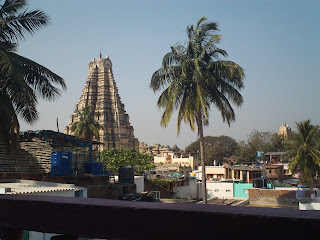
The view from where we eat breakfast in Hampi.
 Who's this guy? And why is he sewing us a pillow?
 Taking a ferry into the backwater. Basically just a local bus, but on the water.
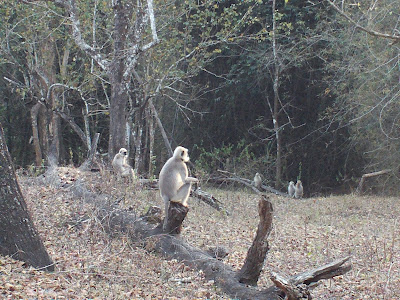
Langur monkeys!
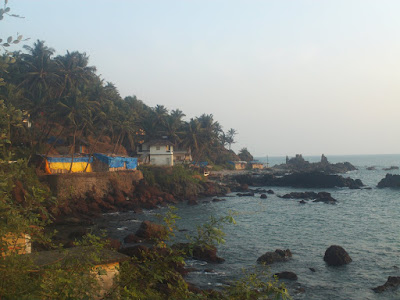
We "had" to pass back through Goa on the way north.
Okay, that's all for now. Lot more where these came from. On to Lucknow.

The view from where we eat breakfast in Hampi.
 Who's this guy? And why is he sewing us a pillow?
 Taking a ferry into the backwater. Basically just a local bus, but on the water.
Langur monkeys!

We "had" to pass back through Goa on the way north.
Okay, that's all for now. Lot more where these came from. On to Lucknow.
Insanely Belated Goa Post
We sleep the whole day on the train south, arrive in Margoa by night. We ask for The Blue Corner, and our rickshaw driver drops us off at darkened stretch of sand and grass. There's a dim lone lantern hanging about 100 meters off inside some kind of thatch shed so we lug our bags in that direction. But no need to fear. Beyond a rise, we find a cluster of huts, one of them ours, and beyond that a restaurant and bar stretching out onto the sand.
Goa's a palm tree and sand kind of place where tourists come to burn themselves black and sip beers under umbrellas. Not much to do but eat and read and watch the fishing boats out at sea.
We have our first fresh pineapple juices. We drink it every day afterward as well. Why have we not been drinking these all our lives?
For dinner, I ask about that day's fish and the waiter brings us five dangling fish to inspect, a sea bass, king fish, a small hammer-headed shark--all with that sad fish frown. I pick a pomphret, a local flat fish that I read about. It's cooked whole with butter lemon and garlic. Delicious!
The sari and sarong women descend on you during the day. They all have the same pitch: tell you their name, make you promise to look again later in the day. B finally buys one, and an angry group of other women surround her, "but you promised US."
Later we wonder if there's some confusion when we say, "Sorry, sorry," to them as they show their wares.
The ocean is warm, and mild, and shallow for a long way out.
We stay two nights in the hut, then move to a colorful orange guest house halfway between the beach and the tiny tourist town. Our hosts mostly ignore us. One day we see them setting up seats and decorations in their dirty driveway and they tell us it's a "holy communion." A little gir in a sparkling pink dress, so she must be the one. That night there's singing and machine-gun fireworks.
A rooster wakes us up. LONG before the dawn. Cows wander in street and in the yards between houses. A dog barks and piglets run for cover. B has been scared of dogs since I told her rabies can be spread by a lick from a monkey or dog. At breakfast a small golden dog sneaks up and licks her leg beneath the table, then trots away, quite satisfied with himself.
We rent a motor scooter. I practice in front of the rental shop, a woman's house. B is not impressed. "I'm not getting on that thing." I can't say I blame her. It takes me awhile to get the knack. "Easy," says the scooter woman. "Children drive it." Finally, after a few practice trip up and down the road to the beach, I convince B to climb aboard.
We want to go to Chandor, a nearby town. The scooter rental woman tells us the way: "Straight, straight, just straight down this road. I know. My mother is from Chandor. No left no right, just straight, straight. I know."
Within 500 meters our street run into a larger street. There is no straight. Two girls point us in the right direction. But once we get to Margao we are lost again. People seem to want to help, but a man on a motorcycle with a child sends us one way, and a group of young men at a snack stand send us back. And so it goes. No street signs. Never sure if we're going the right way. Pulling over whenever we see someone to ask for help, but only getting vague waves back. At last we leave the town. The scenery is beautiful. Rice paddies, a winding road like a snake. We DO see children driving scooters, also whole families on scooters, also stacks of boxes on scooters held together somehow by a boy riding on back. "Are we close to Chandor?" we ask again to a woman standing in the shade. She looks confused. "Chandor, Chandor?" we beg. "This is Chandor," she says.
We went to Chandor to see a 400 year old Portuguese mansion that was built divided in half for two brothers long ago. For awhile we can't find anyone and wander in the shadowed outer stairs and walkways. After some knocking, the two massive wooden doors open, and we've given a tour by a portly gassy coughing guide, who, once you get past his accent, actually speaks some of the best English we have encountered. His side of the house is rather shabby. While the ballroom is still impressive with its chandeliers and gleaming tiles, and there are a few interesting antiques, such as a fake-drawer that opens into a chamber pot, the place is also filled with kitsch and trash. The highlight though, inner chapel holding, encased in gold, the fingernail of St. Francis Xavier. Shortly after that, he draws our attention to an old refrigerator that no longer works. Beyond a closed door we hear a child cry, and our guide tells us that is a 16th-generation member of the family.
On the other side we are greeted by an old woman, surely in her eighties who has lived her whole life in this mansion in the middle of nowhere. It is a treasure trove of china, gorgeous furniture inlaid with pearl, sandelwood chairs, ivory, heirlooms and artifacts. She seems to only want to tell us the age of each in a prerecorded voice "three hundred years old, one hundred fifty, two hundred years old..." but I'm more interested in an old photo of a woman in pearls and a fancy dress. "Who's this?" "My mother," the lady says. The dining room seats eighty, all served with matching tableware from China. "We haven't had big dinners for a long time," she says. "You grew up here?" "Yes, but I was not allowed to play inside."
On the way home we particularly enjoy a long stretch of road surrounded by farms and greenery. After awhile it becomes clear to us that we driving the wrong way again.
We are bored of Goa. It is very nice, but we're restless already to move on, see what else India has got.
Goa's a palm tree and sand kind of place where tourists come to burn themselves black and sip beers under umbrellas. Not much to do but eat and read and watch the fishing boats out at sea.
We have our first fresh pineapple juices. We drink it every day afterward as well. Why have we not been drinking these all our lives?
For dinner, I ask about that day's fish and the waiter brings us five dangling fish to inspect, a sea bass, king fish, a small hammer-headed shark--all with that sad fish frown. I pick a pomphret, a local flat fish that I read about. It's cooked whole with butter lemon and garlic. Delicious!
The sari and sarong women descend on you during the day. They all have the same pitch: tell you their name, make you promise to look again later in the day. B finally buys one, and an angry group of other women surround her, "but you promised US."
Later we wonder if there's some confusion when we say, "Sorry, sorry," to them as they show their wares.
The ocean is warm, and mild, and shallow for a long way out.
We stay two nights in the hut, then move to a colorful orange guest house halfway between the beach and the tiny tourist town. Our hosts mostly ignore us. One day we see them setting up seats and decorations in their dirty driveway and they tell us it's a "holy communion." A little gir in a sparkling pink dress, so she must be the one. That night there's singing and machine-gun fireworks.
A rooster wakes us up. LONG before the dawn. Cows wander in street and in the yards between houses. A dog barks and piglets run for cover. B has been scared of dogs since I told her rabies can be spread by a lick from a monkey or dog. At breakfast a small golden dog sneaks up and licks her leg beneath the table, then trots away, quite satisfied with himself.
We rent a motor scooter. I practice in front of the rental shop, a woman's house. B is not impressed. "I'm not getting on that thing." I can't say I blame her. It takes me awhile to get the knack. "Easy," says the scooter woman. "Children drive it." Finally, after a few practice trip up and down the road to the beach, I convince B to climb aboard.
We want to go to Chandor, a nearby town. The scooter rental woman tells us the way: "Straight, straight, just straight down this road. I know. My mother is from Chandor. No left no right, just straight, straight. I know."
Within 500 meters our street run into a larger street. There is no straight. Two girls point us in the right direction. But once we get to Margao we are lost again. People seem to want to help, but a man on a motorcycle with a child sends us one way, and a group of young men at a snack stand send us back. And so it goes. No street signs. Never sure if we're going the right way. Pulling over whenever we see someone to ask for help, but only getting vague waves back. At last we leave the town. The scenery is beautiful. Rice paddies, a winding road like a snake. We DO see children driving scooters, also whole families on scooters, also stacks of boxes on scooters held together somehow by a boy riding on back. "Are we close to Chandor?" we ask again to a woman standing in the shade. She looks confused. "Chandor, Chandor?" we beg. "This is Chandor," she says.
We went to Chandor to see a 400 year old Portuguese mansion that was built divided in half for two brothers long ago. For awhile we can't find anyone and wander in the shadowed outer stairs and walkways. After some knocking, the two massive wooden doors open, and we've given a tour by a portly gassy coughing guide, who, once you get past his accent, actually speaks some of the best English we have encountered. His side of the house is rather shabby. While the ballroom is still impressive with its chandeliers and gleaming tiles, and there are a few interesting antiques, such as a fake-drawer that opens into a chamber pot, the place is also filled with kitsch and trash. The highlight though, inner chapel holding, encased in gold, the fingernail of St. Francis Xavier. Shortly after that, he draws our attention to an old refrigerator that no longer works. Beyond a closed door we hear a child cry, and our guide tells us that is a 16th-generation member of the family.
On the other side we are greeted by an old woman, surely in her eighties who has lived her whole life in this mansion in the middle of nowhere. It is a treasure trove of china, gorgeous furniture inlaid with pearl, sandelwood chairs, ivory, heirlooms and artifacts. She seems to only want to tell us the age of each in a prerecorded voice "three hundred years old, one hundred fifty, two hundred years old..." but I'm more interested in an old photo of a woman in pearls and a fancy dress. "Who's this?" "My mother," the lady says. The dining room seats eighty, all served with matching tableware from China. "We haven't had big dinners for a long time," she says. "You grew up here?" "Yes, but I was not allowed to play inside."
On the way home we particularly enjoy a long stretch of road surrounded by farms and greenery. After awhile it becomes clear to us that we driving the wrong way again.
We are bored of Goa. It is very nice, but we're restless already to move on, see what else India has got.
Subscribe to:
Posts (Atom)