Wednesday, February 24, 2010

Photos

This computer actually seems halfway "fast" so I want to try to post a couplep photos. (My video won't load, for some reason...) Well, here's a few shots. Think of them as teasers for my longer posts, if I ever get around to them.


Brittany and Lakshmi, the temple elephant.


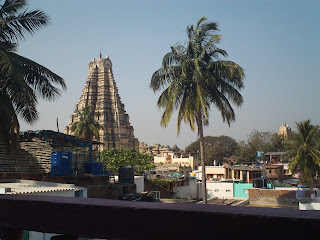
The view from where we eat breakfast in Hampi.

Who's this guy? And why is he sewing us a pillow?

Taking a ferry into the backwater. Basically just a local bus, but on the water.


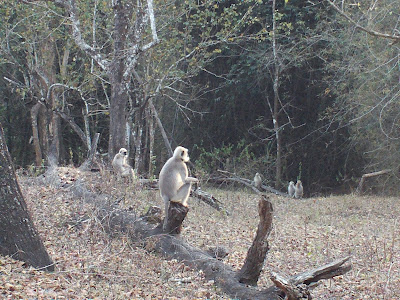
Langur monkeys!


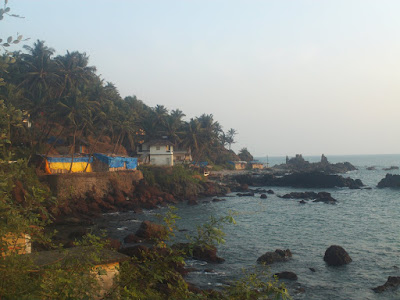
We "had" to pass back through Goa on the way north.

Okay, that's all for now. Lot more where these came from. On to Lucknow.


Insanely Belated Goa Post

We sleep the whole day on the train south, arrive in Margoa by night. We ask for The Blue Corner, and our rickshaw driver drops us off at darkened stretch of sand and grass. There's a dim lone lantern hanging about 100 meters off inside some kind of thatch shed so we lug our bags in that direction. But no need to fear. Beyond a rise, we find a cluster of huts, one of them ours, and beyond that a restaurant and bar stretching out onto the sand.

Goa's a palm tree and sand kind of place where tourists come to burn themselves black and sip beers under umbrellas. Not much to do but eat and read and watch the fishing boats out at sea.

We have our first fresh pineapple juices. We drink it every day afterward as well. Why have we not been drinking these all our lives?

For dinner, I ask about that day's fish and the waiter brings us five dangling fish to inspect, a sea bass, king fish, a small hammer-headed shark--all with that sad fish frown. I pick a pomphret, a local flat fish that I read about. It's cooked whole with butter lemon and garlic. Delicious!

The sari and sarong women descend on you during the day. They all have the same pitch: tell you their name, make you promise to look again later in the day. B finally buys one, and an angry group of other women surround her, "but you promised US."

Later we wonder if there's some confusion when we say, "Sorry, sorry," to them as they show their wares.

The ocean is warm, and mild, and shallow for a long way out.

We stay two nights in the hut, then move to a colorful orange guest house halfway between the beach and the tiny tourist town. Our hosts mostly ignore us. One day we see them setting up seats and decorations in their dirty driveway and they tell us it's a "holy communion." A little gir in a sparkling pink dress, so she must be the one. That night there's singing and machine-gun fireworks.

A rooster wakes us up. LONG before the dawn. Cows wander in street and in the yards between houses. A dog barks and piglets run for cover. B has been scared of dogs since I told her rabies can be spread by a lick from a monkey or dog. At breakfast a small golden dog sneaks up and licks her leg beneath the table, then trots away, quite satisfied with himself.

We rent a motor scooter. I practice in front of the rental shop, a woman's house. B is not impressed. "I'm not getting on that thing." I can't say I blame her. It takes me awhile to get the knack. "Easy," says the scooter woman. "Children drive it." Finally, after a few practice trip up and down the road to the beach, I convince B to climb aboard.

We want to go to Chandor, a nearby town. The scooter rental woman tells us the way: "Straight, straight, just straight down this road. I know. My mother is from Chandor. No left no right, just straight, straight. I know."

Within 500 meters our street run into a larger street. There is no straight. Two girls point us in the right direction. But once we get to Margao we are lost again. People seem to want to help, but a man on a motorcycle with a child sends us one way, and a group of young men at a snack stand send us back. And so it goes. No street signs. Never sure if we're going the right way. Pulling over whenever we see someone to ask for help, but only getting vague waves back. At last we leave the town. The scenery is beautiful. Rice paddies, a winding road like a snake. We DO see children driving scooters, also whole families on scooters, also stacks of boxes on scooters held together somehow by a boy riding on back. "Are we close to Chandor?" we ask again to a woman standing in the shade. She looks confused. "Chandor, Chandor?" we beg. "This is Chandor," she says.

We went to Chandor to see a 400 year old Portuguese mansion that was built divided in half for two brothers long ago. For awhile we can't find anyone and wander in the shadowed outer stairs and walkways. After some knocking, the two massive wooden doors open, and we've given a tour by a portly gassy coughing guide, who, once you get past his accent, actually speaks some of the best English we have encountered. His side of the house is rather shabby. While the ballroom is still impressive with its chandeliers and gleaming tiles, and there are a few interesting antiques, such as a fake-drawer that opens into a chamber pot, the place is also filled with kitsch and trash. The highlight though, inner chapel holding, encased in gold, the fingernail of St. Francis Xavier. Shortly after that, he draws our attention to an old refrigerator that no longer works. Beyond a closed door we hear a child cry, and our guide tells us that is a 16th-generation member of the family.

On the other side we are greeted by an old woman, surely in her eighties who has lived her whole life in this mansion in the middle of nowhere. It is a treasure trove of china, gorgeous furniture inlaid with pearl, sandelwood chairs, ivory, heirlooms and artifacts. She seems to only want to tell us the age of each in a prerecorded voice "three hundred years old, one hundred fifty, two hundred years old..." but I'm more interested in an old photo of a woman in pearls and a fancy dress. "Who's this?" "My mother," the lady says. The dining room seats eighty, all served with matching tableware from China. "We haven't had big dinners for a long time," she says. "You grew up here?" "Yes, but I was not allowed to play inside."

On the way home we particularly enjoy a long stretch of road surrounded by farms and greenery. After awhile it becomes clear to us that we driving the wrong way again.

We are bored of Goa. It is very nice, but we're restless already to move on, see what else India has got.

Thursday, February 11, 2010

Belated Mumbai Post

Our airport taxi driver pulls over inexplicably as we start to leave the airport area, walks away. A woman with a child begins begging at B's window. Out of an upstairs airport facility window, someone throws out a bucketful of brown water and trash. Okay, we're a little freaked out.

On the ride from the Mumbai airport. A man riding a bicycle through the slum with two exquisitely and traditionally dressed boys perched on each handle bar. Our first sight of Brahmin Cows pulling an old man perched on a cart made out of an oil drum.

"Honk please OK" painted on the back of most cars. You can't possibly see where everyone is. You need them to tell you. You can't possibly dodge every vehicle, you have to have to honk and have faith they'll hear you, avoid you.

Groups of boys in flared pants and silk shirts strut among the traffic and madness of the slums. It's a disco look. Everyone has great posture here.

How do these houses not fall down? Three stories high and made out of paper and twigs by all appearances.

The grandeur of the British buildings in Fort. Now there are huts built on massive granite balconies. B: "It's like aliens landed on an abandoned planet."

Our Mumbai hotel, a shabby but clean affair, must have twenty bellhops, from kids to old men. They sleep, read newspapers, eat in the hallways. There's a window in the hall outside our door so they conglomerate there. I've seen some sitting in empty rooms watching cricket on television. We had an "A/C" room so a group of four kids carried in an AC unit for the window. One oversaw the action from the hall. It seems like in India, like they say about ancient Rome, ancient Egypt, the technology that powers the society is human-power, just lots and lots of people.

I'm constantly curious about the economics of things. Who gets paid, how much? At night the staff of restaurants sleep on and under the tables they served food on. Is this their pay?

The book talks about how the Mumbai slums are a massive recycling factory made up of a million single rooms. Melting down tin, saving scrap silicon, turning rocks into gravel.

At times this country seems TOO efficient. A squatting man soaks up extra oil at a gas station to us for... what? There's a leak in a hose outside a museum and ten women gather to use the water for laundry. Everywhere you look is a testament to human resilience and creativity. And also to a population exploded out of control. The planet can support this many people, probably billions more, but do we always need to test that maximum capacity?

From our hotel window we watch the people sleeping on the roof below us waking up. Someone dressed in fancier clothing comes and wakes them rudely up. Most of them go back to sleep after he leaves, but one old starts doing laundry in a bucket. When we get back that night she's still at it.

Just beyond the roof filled with sleeping people is the Gothic and grandiose Victoria Terminal.

Part of the thrill of India is like watching the dynamics of an anthill, except you're an ant yourself. How does it all work? How do people know where to go? What to eat? What to pay? What to carry? How do I fit into all this?

First night out, while B sleeps. No street signs. Too scared for now to venture off the main roads into the teeming back alleys. A kitten tries to cross the street, walking first under a temporarily stopped taxi. There must be seven more vehicles to pass to get to the other side. It seems like certain death. I can't watch.

Everywhere you see people squatting flatfooted. Working on something, resting, brushing their teeth. It's very hard to do. Try it. Your legs and ankles start to hurt.

Potato chips flavored after different Indian meals. Yum.

Jet lag. We can't seem to stay up late enough for the sunset. We We wake up in the middle of the night. "You awake?" "You awake?" The honking has miraculously died down. Where are we?

Friday, February 5, 2010


Kids playing cricket across a Mumbai street. They have to play around buses and dogs and cows. I feel like this is a good example of the life-stacked-upon-life quality found everywhere in India. If there's an extra seat on your scooter than someone will be sitting on it, if there's a patch of earth between the railroad tracks than someone will plant some banana trees there. (This is from our first few days in India...)

Thursday, February 4, 2010

Hampi


We are now in Hampi (that's the view from our rooftop cafe), an ancient royal and religious town known for it's bazaar and many temples (and as far as I can tell, monkeys!), in the Karnataka region. We arrived here by train from Goa after a relatively short 6 hour eastbound ride. It's pretty amazing--the landscape is gorgeous--it's in the desert and there are boulders and temples and tropical plants and trees (including large mango ones and banana forests), and then there are these amazing temples sticking out all over the place. The bazaar is really impressive too--it lines the main street and you can still buy all kinds of fine jewelry, silver, and gems there. We haven't done any shopping yet, but I think we're going to make our rounds today to see if we can pick up some genuinely nice things to bring home. The streets around the bazaar are very small and winding, making it easy and fun to get lost without going very far. We' are staying in a nice guesthouse (called Vicky's if you want to google it) on one of the side-streets that has a restaurant on the roof with some of the best views of the city (and hot showers!). At night, the goats come in from pasture and it's quite a little parade, with the two baby goats being carried by their shepherd (?) at the caboose (it's quite a sight and really adorable). Every morning we have breakfast up on the roof and it's pretty amazing to see the temples in the distance, and monkeys climbing all over the rooftops of neighboring buildings. There's a terrace with some chairs and a swing just outside of our room that affords us the opportunity to be total voyeurs of the people all over the street, and it's where Nathan has been able to get some writing done in the mornings while it's not too hot outside. We are right near the river too (I can't remember what it's called--everything here has an impossibly long name) so we've had a nice breeze and some cool nights as well. Although the days here are hot and dry, we've been exploring much of our surroundings. We've visited several temples, where Hanuman seems to be pretty popular (he is the monkey god!) and there are of course several statues and carvings of Krishna, Vishnu and his wife Lakshmi. Shiva's image can be found everywhere (including a paper mask of him perched on our neighbor's roof), and we've noticed several people in town with 3 white line markings on their foreheads which indicates they are of a particular sect that honors Shiva (while apparently a white V means you are a loyal follower of Krisha and Vishnu). One night we climbed some boulders behind a temple to watch the sunset--we've tried to take some pictures of this one and the sun over the Arabian Sea, but I don't think we were able to capture just how incredible it is here. We also visited some ancient baths, watchtowers, and royal elephant stables. Today (our last day here) we are going to explore the Virupaksha temple right in the center of the city and hopefully see its resident elephant (also called Lakshmi) who will kiss you for a coin.

Because of Hampi's religious significance, it is illegal to consume meat and alcohol within the city's borders. After a long day of touring temples with our guide Sado and his trusty auto-rickshaw (more on him later), Nathan and I were craving a cold beer pretty badly, so we paid 15 Rupees (about 30 cents) to cross the river in a motorboat to the city on the other side (known for it's more laid back atmosphere and several ashrams) where we could have one (although they are not listed on the menu). We also found out that some of the restaurants in Hampi do serve beer, but are extremely secretive about it. Last night our waiter made a special run out for a 6 pack of Kingfisher for Nathan and I and a table of 4 seated near us. He was gone for a while, so I assume he either crossed the river or went into Hospet (the closest train station town) to pick some up. They ended up costing about twice as much as they should, and we had to hide them under our table during dinner which made things interesting.

We leave tomorrow morning--back to Goa (staying right near the Vasco de Gama train station and close to the Dabolim airport) for one night before flying down to Trivandrum on Sunday. Trivandrum is right near the southernmost point of India and is the capital of the region of Kerala--supposedly one of the most beautiful places on earth-- jungles, beaches, wildlife preserves, and old british hill train stations.. We will spend two weeks making our way north through Kerala before arriving in Goa (again, but this time in the northern part) to see our friend from New York for a few days.

I planned on uploading some pictures today, but apparently, despite bringing 8 million different cords, the one that connects my camera to the computer was not one of them. Nathan's taken some pictures on another camera, but he uses it mostly for short videos (which I also tried to upload, but this particular computer will not accept). Hopefully he can try to put them up later, and I'll just have to wait until we get home to put up mine!

Goa

From Mumbai we took the train down to South Goa. The ride was about 12 hours, and we opted for a day train because it's supposedly one of the most scenic rides in India (although I passed out cold around noon for the rest of the trip, missing the best views). Figuring out the train system has been one of the most stressful things about India. There are 7 different classes of cars, and other than their prices, we couldn't really decipher the differences when we were booking our first seats. We ended up riding in 3AC for this trip, which is the 3rd class from the top and is air conditioned. This means there were 8 people total in our "berth" (which is like a section of a train car you share), six people in the main area, with 2 rows of 3 bunk beds that the seats fold out into at night, and then one set of two seats/bunks on the side. For a long day trip, it was rather pleasant and we made conversation with one of the Indian women traveling to see her friends in Goa. Men walk up and down the aisles, selling chai tea, coffee, samosas and dosas, but we instead ate the lunch that was provided by the Indian Rail (Chinese food, which is as ubiquitous here as it is in New York.) You have to book train seats well in advance or risk being put on the wait list, where you don't find out if you're guaranteed a seat until a few hours before departure. This is a bit frustrating since we wanted to have more leeway in deciding how long to remain in one region before traveling on, yet we found out you can always book multiple tickets on different days and cancel them for just pennies (and a refund) if your waitlisted seat ends up becoming available.

That night when we arrived in Goa, a taxi took us to the town of Benaulim Beach in the south region where we stayed for the next week. When the driver dropped us off on this remote road late at night and just motioned toward a light in the distance as our destination, we felt a little unsure about it, but after a just a couple of minutes walk toward the beach we saw the sign for our place, their nice restaurant, and the warm Arabian Sea. For our first two nights, we slept in palm huts right on the beach (called the Blue Corner, if you want to google it). It's as rustic as it soundsc (but had eletricity, a mosquito net-covered bed and nice slate floor shower). I read that every monsoon season they wash away into the sea and are rebuilt for the next tourist season.

Goa is a popular vacation destination for Europeans, Russians, and north Indians. (In some ways it reminded me of the Florida Keys, except in Goa there are cows, pigs, dogs and chickens running amok). We knew this coming in, but we thought it might be nice to have a softer entry into India where we could get our bearings before moving on (and it was). Although the locals on the beach and main streets are constantly beckoning you to come in and buy their goods, Goa is almost TOO relaxed: beaching, eating fresh fish (Nathan had a pomphret that was freshly caught one day), napping, drinking fresh fruit drinks, so we felt a little bored rather quickly. We decided to move from the remote huts into a much cheaper guesthouse (essentially a furnished room in a house, like in a bed and breakfast-$7.50/night as opposed to $25 at the hut) that was down the road between the beach and the main town. We slept long hours, but every morning around 4am the neighboring rooster would begin crowing this insane version of cock-a-doodle-do, and we'd be up til 6am or so before crashing again til 7:30 or 8. Most days we got up early, ate breakfast (the eggs here are some of the freshest and best I've ever had, and a cold fresh pineapple juice has become standard fare), walked on the beach, swam in the sea, and returned to the restaurant at the Blue Corner for dinner since they had the best food and atmosphere of all the local restaurants. We rented a motorscooter one day, and after Nathan spent a couple of hours driving up and down the main road to get the feel for it, we took a trip out to this old Portugese mansion in a middle-of-nowhere town called Chandor (where we got lost coming to and going from, but had some great serendipitous scenic views along the way). The house was built by two brothers, each lived in one side, and now their descendants (14th and 15th generations) still live there. We were given a tour of both sides of the house-- each has aged differently over time, but both have grand ballrooms full of Chinese porcelain, silk love seats, and crystal chandeliers. The woman who gave us a tour of her family's side must have been 80+ years old, and had lived in the house her whole life. (There's Nathan + scooter + mansion on the left...)

We spent quite a bit of time in the internet cafe, planning our next moves before we left Goa (on Tuesday) for a town 6 hours east (that I will write about tomorrow before we leave). Nathan has been busy working, but I hope he will have some time to write his thoughts on Mumbai and South Goa and fill in some gaps that I've missed.

Monday, February 1, 2010

First India Post!

First off, sorry for the delay in writing this first post.  We've only been here one week, but it's been hectic and crazy (in a good way).  We arrived in Mumbai last Monday, and as the plane descended we could see all of the slums surrounding the airport.  It was a really incredible way to enter the country, and we were both pretty astonished to find out that it is the largest slum in India.  (I think 8 million people live there.)  Despite the horror stories we heard about trying to leave the airport and get a taxi to our hotel, everything went rather smoothly.  Our cab driver wasn't a talker, and Nathan and I were both too stunned by the freeway and the sights along it to carry on typical post-flight chatter.  Cars, auto-rickshaws, mopeds and cows crowd the highway, each vehicle blaring it's horn to warn the one in front of it that it's coming up behind.  The slums along the edges are such a sight too, it's just one ramshackle hut after another, and they go on and on and on but everyone seems so industrious.  Everyone is doing something--embroidering shirts, sewing soft shoes, selling goods, or more likely, picking up trash and carrying tons of it in bags on their heads.  (We figure the reason that so many people here have great posture is that they carry loads of things on their heads--we saw men leaving the train station with giant baskets of flowers on their heads one early morning, and the women selling saris on the beach typically carry them that way too.)

After a bit of miscommunication with our driver and the fact that street names are hard to come by, we got a bit lost but ultimately made it to our hotel in the Fort area of Mumbai which is near the giant Victoria Terminus central train station (where we departed for Goa two days later).  Fort is a very commercial area, and so after sleeping off our jet lag, the next day (our only full one in Mumbai) we walked through the wide streets and beautiful old colonial buildings (including the university) down to Colaba, the southernmost part of Mumbai.  We saw the few sights there are to be seen there (the Gateway to India port, the Taj Mahal hotel that was attacked last year) and then headed to a lackluster lunch.  Later we wandered up to Chowpatty Beach, where I thought the stench of trash was rather unbearable and we didn't stay long before heading to a really nice dinner near our hotel. 

We left early the next morning for Goa, so we didn't get to experience too much of Mumbai.  There are a million things more I want to write about it, but I'm already feeling foggy and the internet cafe is closing in a few minutes, so I will just tell you my favorite thing about India so far--the head bobble.  Nathan's friend Gabe introduced us to this concept, but it's really awesome to see it in real life.  When the people here are telling you "yes" or that "something is fine" or "thank you" or "your welcome" they don't often say those words (although they all speak English VERY well), instead they do this loose-neck head bobble while staring at you.  I had to stifle a laugh the first few times because it's pretty adorable, but now I look forward to getting that gesture.  The only problem is that whenever we try to tell a salesperson NO (which happens quite often), Nathan and I tend  to shake our heads in the negative, which is then confusing to them since it means the opposite.

OK gotta run.  I promise another update soon!

And if you're worried (parents!), we're both doing fine, sleeping plenty and eating healthy.